
Gyoda’s Japan
Heritage Story
Gyoda is a city in Saitama Prefecture on the central Kanto Plain. It is Japan’s leading producer of tabi (split-toe socks), and its backstreets are dotted with tabi storehouses. Constructed using a range of materials—including stone, brick, mortar, reinforced concrete, and wood— these buildings are part of a unique townscape that tells the story of a 300-year-old industry.
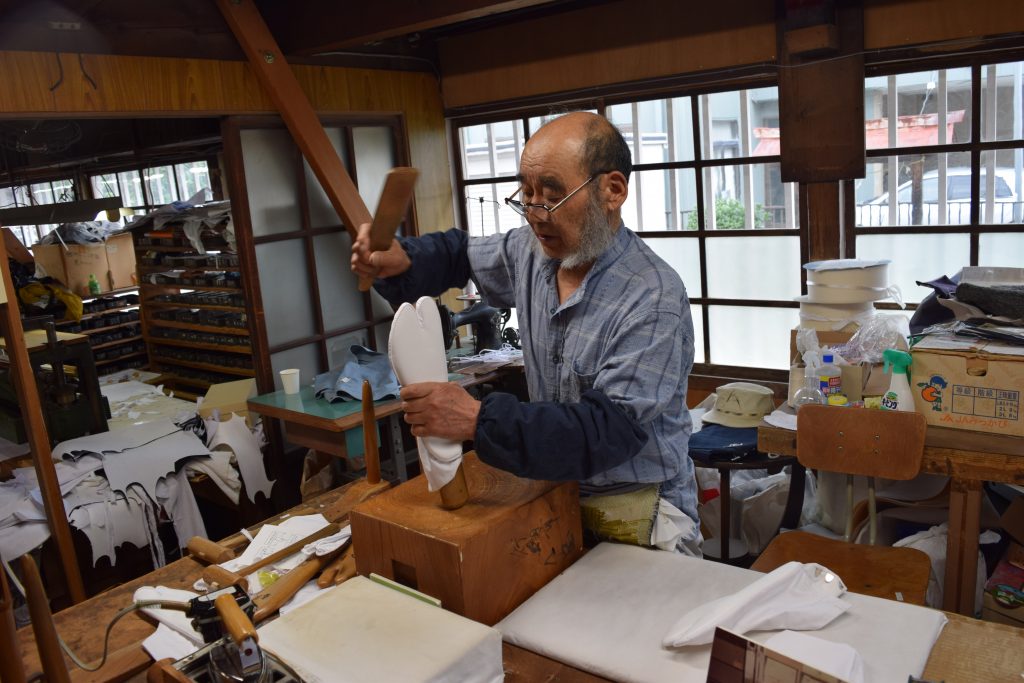
Tabi craftsman
The origins of tabi productionion
Geography is the main reason for the development of the tabi industry in Gyoda. Flanked by the Tone and Arakawa Rivers, the region’s fertile sandy soil, abundant water, and high summer temperatures provide the ideal conditions for cultivating cotton and indigo. By the seventeenth century, these natural resources, combined with a local heritage of sewing, laid the foundation for tabi manufacturing.
According to local lore, the ruling daimyo (regional lord) of the Oshi domain encouraged the wives and daughters of his samurai to make tabi to supplement their income. The craft gained rapid renown; by 1765, Gyoda’s footwear was featured in the Tokai Kiso Ryodochu Kaiho Zukan, a famous guide to regional wares. Unlike other trades, the tabi industry was not restricted by merchant guilds, allowing it to remain open and competitive. This freedom allowed the industry to flourish, with the 3 shops recorded in the early 1700s multiplying to 27 by the mid-nineteenth century.
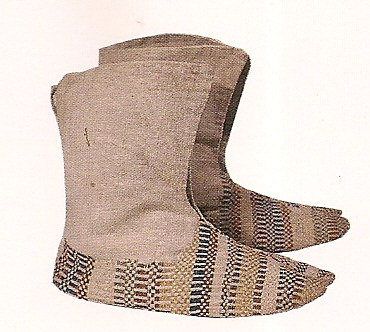
Sashi tabi (quilted tabi)
Industrial modernization and the need for storage
As Japan modernized during the late nineteenth century, the demand for tabi increased significantly. Gyoda merchants bypassed traditional wholesalers, traveling directly to Tohoku and Hokkaido to establish exclusive sales networks and secure military contracts. By doing so, Gyoda surpassed rival regions to become the nation’s primary production hub.
The economic boom that followed the Russo-Japanese War (1904–1905) triggered a period of industrial development within the town. Specialized sewing machines were introduced, streamlining the manufacturing process, which in turn led to a surge in factory construction. Tabi were manufactured year-round but sold predominantly during the autumn, creating a need for large-scale storage. This led to a boom in the construction of storehouses to protect inventory until shipment.
Urban evolution and the “linear” townscape
During the fifteenth and sixteenth centuries, Gyoda was a castle town. At the time, taxes were based on the width of a property’s street frontage. To lower their tax burden, landowners developed long, narrow “strip-style” lots. This layout was further influenced by Gyoda’s role as a major post station, where the rear portions of properties were used to stable travelers’ horses. As travel modernized, these backyards sat idle, later becoming the perfect location for tabi factories and storehouses.
This evolution resulted in a unique linear arrangement that is characteristic of Gyoda’s merchant estates. A typical property began with a commercial space and residence facing the street, followed by a courtyard for receiving guests, a factory, and finally a storehouse and a small Inari shrine at the rear. The shrine was intended to guard against fire, the greatest threat to the flammable cotton inventory.
Structural diversity and architectural innovation
Gyoda’s storehouses offer a visual timeline of a century of innovation. To protect the flammable cotton, buildings had thick earthen walls and minimal northwest-facing windows to block winter winds. Internally, the structures were optimized for utility: support pillars were concentrated in the exterior walls to leave the central floor space open for handling bulky materials, while floors were elevated to improve ventilation and prevent moisture damage.
Until the late nineteenth century, tabi storehouses were primarily made with earthen walls. By the early 1910s, however, Western-style architectural techniques were introduced, such as the use of trusses in roofs and stone for walls. From the mid-1910s to the early 1920s, storehouses were built on a larger scale, utilizing steel frames and bricks. By the 1930s, materials evolved to include mortar, concrete, and wood. During and after World War II (1939–1945), material shortages led to a resurgence of stone as the primary construction material.
The diversity of storehouses seen today is a result of Gyoda’s unique business culture. As the industry grew, it did not consolidate into massive corporations. Instead, successful employees would often set up their own independent branches in a practice known as noren-wake. This allowed over 200 small- to medium-sized shops to coexist at the industry’s peak, each building its own storehouse using the latest architectural styles of the time.
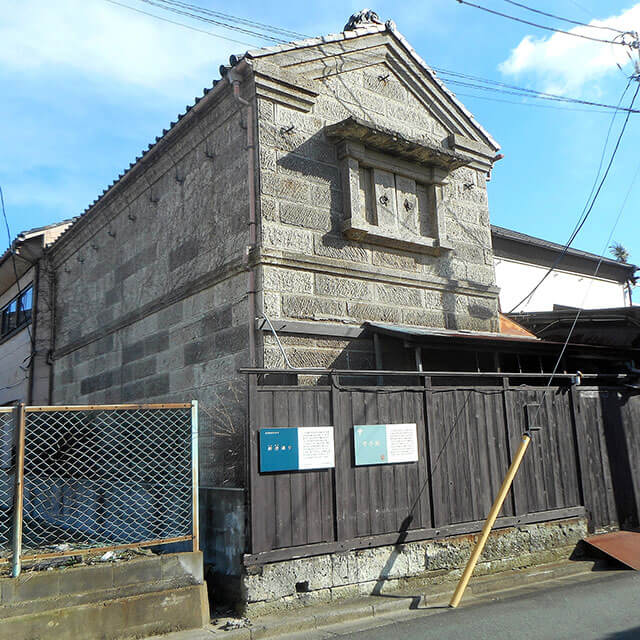
Post-war stone storehouse (Koushi storehouse)
The peak of the tabi industry
Gyoda’s merchants maintained exclusive sales networks, dealing directly with specific regions to ensure market stability. For example, the Rikiya Tabi Shop focused on Hachinohe in Aomori, while the Dofu Tabi Shop supplied the Osarizawa Mine in Akita. Through these direct channels, sales expanded nationwide and eventually overseas.
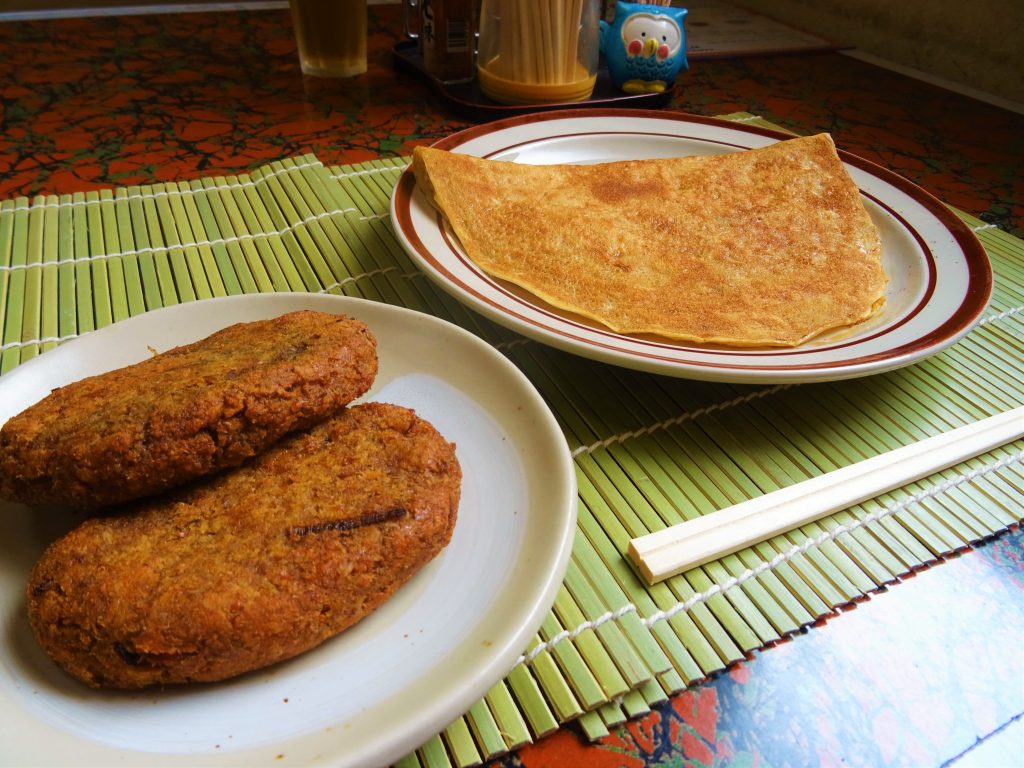
“Zeri” fried snack (left)Fried snack (right)
During this peak period, the industry involved nearly the entire population of Gyoda. This labor-intensive environment gave rise to a distinct local food culture, including furai (a crispy savory pancake) and zeri furai (a type of soy-pulp croquette), which served as quick handheld snacks for busy workers. Narazuke, or pickles seasoned in sake bran, became a standard gift used by merchants to maintain client relationships. By the late 1930s, Gyoda produced approximately 80% of Japan’s tabi, a legacy immortalized in regional folk songs.
Preserving a living industrial heritage
While modern footwear has changed the market, tabi production continues in Gyoda. The city remains Japan’s top producer of tabi, regularly introducing new designs for domestic and international consumers. Approximately 80 tabi storehouses remain standing today, serving as symbols of the city’s twentieth-century industrial prosperity.
The rhythmic hum of sewing machines still creates a soundscape unique to the backstreets of Gyoda. By repurposing historic storehouses for modern businesses, the city continues to preserve its architectural charm while maintaining its 300-year-old industrial legacy.